
It is often somewhere around 2am when the question arrives.
Your baby is fussing. You are tired in a way you didn’t know was possible. And there, on the shelf, is a bottle of oil you’re half-afraid to open, because somewhere between your mother’s confident hands and the hundred conflicting things you’ve read online, you’ve started to wonder whether you’ll get this wrong.
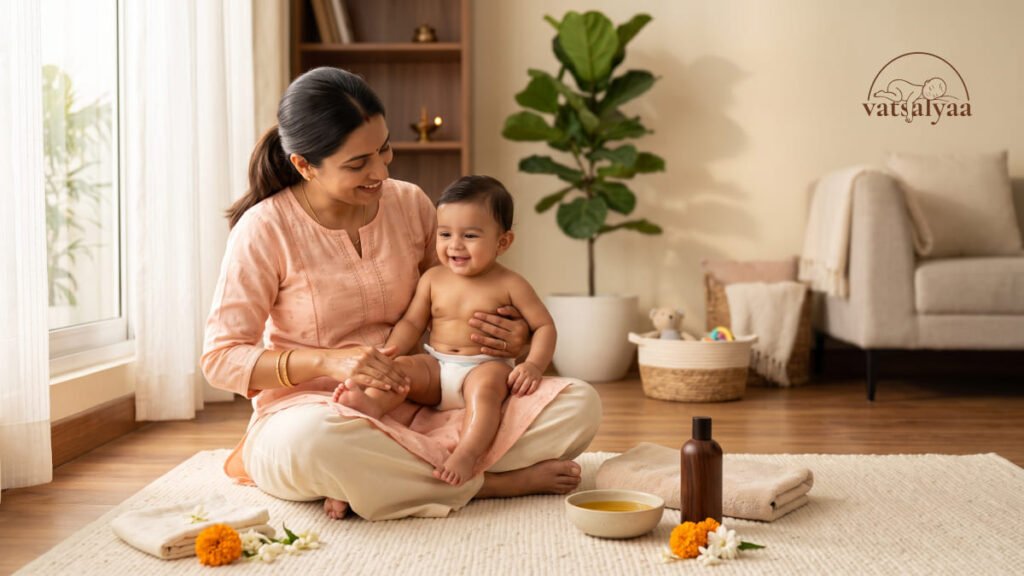
If that’s you, take a breath. You’re in exactly the right place.
Because here is the truth that gets lost under all the advice: baby massage is one of the very few things in early parenting that is genuinely hard to get wrong. Your grandmother did it without a single tutorial. Your mother did it while half-asleep. And you already carry more of this knowledge in your hands than you think.
This guide will walk you through all of it, what massage actually does, when to start, which oil to reach for, and a simple step-by-step routine you can trust. Gently, honestly, and without a trace of fear.
What Baby Massage Really Is (and Why India Has Done It for Centuries)
Baby massage is the practice of stroking your baby’s body slowly and softly, usually with a little warm oil, in a calm and unhurried way.
That’s it. No special training. No perfect technique to master.
In India, this practice has a name and a lineage: shishu abhyanga, the traditional daily oil massage that has been part of newborn care for generations. Long before anyone measured its benefits, mothers and grandmothers understood something instinctively, that malish was never really about the oil. It was about touch. Warmth. The feeling of being held and known. A daily conversation between two people who were still learning each other.
Modern research has quietly caught up with that instinct. Studies suggest that gentle, loving touch can help babies feel calmer and more settled, and may support bonding between parent and child. For premature and at-risk infants under medical supervision, research has even pointed to benefits like healthier weight gain and lower stress. It’s meaningful, but it isn’t magic, and we’ll always be honest with you about the difference.
It helps to separate two ideas here. There’s clinical “massage therapy,” which sounds technical and intimidating. And then there’s malish, the soft, everyday, loving practice you’re actually here for. You are not training to be a therapist. You are simply spending gentle time with your baby.
There’s a reason the word sneha sits at the heart of this. In Sanskrit, it means oil and love and tenderness, all at once. Which is a rather beautiful way of saying: the oil was always only ever the beginning.
The Real Benefits – What Massage Can and Can’t Do
Let’s talk honestly about what to expect, because false promises help no one at 2am.
For your baby, gentle massage may:
- Help them feel calmer and more secure
- Support deeper, more settled sleep
- Ease the discomfort of trapped gas
- Keep delicate skin soft and moisturised
- Create a predictable, soothing rhythm to the day
For you, it can:
- Build your confidence in handling your baby
- Help you learn to read their cues and moods
- Offer a few unhurried, screen-free minutes that lower your own stress too
And now the part most guides leave out.
Baby massage is not a guaranteed fix for colic or reflux. Some evenings it will soothe your baby beautifully. Other evenings, nothing will, and that is not a failure on your part. Massage is a bonding ritual with some lovely side effects. It is not a treatment. Holding both of those truths at once is what keeps this practice joyful instead of pressured.
When Can You Start a Baby Massage?
Here’s the direct answer: for healthy, full-term babies, you can begin gentle massage once your baby is settled, commonly after the first week or two.
A few gentle caveats make it safe:
- Wait on the tummy. Avoid the belly and cord area until the umbilical cord stump has fully healed and dried.
- Premature or medically fragile babies come first to the doctor. If your baby arrived early or has any medical condition, check with your pediatrician before you begin. No exceptions here.
And if you’re reading this when your baby is already three weeks, three months, or older and feeling a flicker of “have I left it too late?”, please let that go. There is no expiry date on this. You can start whenever you and your baby are ready. Today counts.
The Best Time (and How Often) to Massage
The best massage happens when your baby is calm, alert, and content, not hungry, not overtired, not mid-meltdown.
Good windows include:
- About 30 to 45 minutes after a feed (not immediately after)
- Before a bath, in the traditional way
- As part of a wind-down before bedtime
It’s kinder to skip massage when your baby is:
- Hungry or has just fed
- Feverish or unwell
- Crying hard or clearly overstimulated
- Freshly vaccinated (avoid the injection site for a few days)
As for how often, daily is lovely, but it is genuinely not mandatory. A few calm sessions a week offer the same bonding and comfort. Follow your baby, not a schedule you feel you’re failing.
Duration can simply grow with your baby:
| Baby’s age | Gentle massage duration |
|---|---|
| Newborn | 5–10 minutes |
| 1–3 months | 10–15 minutes |
| 3–6 months | 15–20 minutes |
Think of these as gentle guides, not targets. If your baby is happy at four minutes and done, that’s a complete massage.
Which Oil Is Best for Baby Massage?
This is the question that keeps parents standing in the supermarket aisle, reading the backs of bottles, quietly wondering: am I overthinking this?
You’re not. It matters. But it’s also simpler than it looks.
The simple rule first: choose an oil that is edible-grade, cold- or wood-pressed, unscented, and free of mineral oil. The reasoning is delightfully practical, babies get their hands and feet into their mouths constantly, so the safest oil is one you’d be comfortable with them tasting.
And always patch-test. Dab a little on a small patch of skin and wait 24 hours before the first full massage, just to be sure it agrees with your baby.
Here’s an honest look at the common choices:
| Oil | Notes | Best For |
|---|---|---|
| Virgin, Wood- or cold-pressed coconut | Light, edible-grade, widely tolerated | Everyday use, warmer months |
| Sweet almond | Nourishing, skip if there’s any nut-allergy risk | Older babies, no allergy history |
| Sesame (til) | Warming; traditional in cooler weather | Winter, traditional practice |
| Sunflower | Light and mild; quality matters | Sensitive skin |
| Mineral oil / generic “baby oil | Petroleum-derived; sits on the surface of skin | Not our recommendation for massage |
A quick seasonal note, the way an experienced dadi might mention it: lighter oils like coconut tend to suit Indian summers, while some families reach for sesame in the cooler months. Whatever you choose, keep the room comfortably warm.
One thing worth understanding, because most brands won’t pause to explain it: wood-pressed oil is extracted slowly, without heat or chemical refining. That means it stays closer to its natural state than heavily refined oils or generic “baby oils”, which are often mineral-oil based and simply rest on top of the skin. It’s a real distinction, and it’s worth knowing what’s actually in the bottle you’re warming between your palms.
This, honestly, is why we press Sneha’s massage oil from wood-pressed coconut, so there’s nothing in it your baby couldn’t safely put in her mouth. But the principle matters more than the brand: read your labels, and choose something you understand.
How to Massage Your Baby, Step by Step
Here is the part you came for, a simple, safe sequence you can follow tonight. We move from the legs upward and finish at the back, because it’s the gentlest, most relaxing progression for most babies.
Before anything else, one small piece of wisdom to carry through all of it: watch her face, not the clock. Her cues lead.
Setting up
Warm the room to a comfortable temperature, around 24°C is lovely. Lay down a soft towel. Warm a little oil between your palms first, so it never lands cold. Wash your hands, trim your nails, slip off your rings, and set your phone somewhere out of reach.
Then undress your baby to whatever level keeps her comfortable, meet her eyes, and talk or hum softly. Narrate what you’re doing. She won’t understand the words, but she’ll understand the tone.
Legs and feet, the friendly start
Legs are the easiest place to begin, and the least likely to startle a baby.
Cup one thigh and stroke gently downward toward the ankle, then switch hands and repeat, a soft, milking motion. Move to the feet: make small circles on the soles with your thumbs, and gently roll each tiny toe between your fingers.
Tummy – only once the cord has healed
If the umbilical stump has fully healed, you can gently massage the tummy in slow, clockwise circles. Clockwise matters, it follows the natural direction of digestion.
Then try the “I Love You” stroke, a gentle old favorite: trace the letter “I” down the left side of her tummy, then an upside-down “L,” then a “U.” Beyond being sweet, this path can help move trapped gas along.
Arms and hands
Just like the legs, cup the shoulder and stroke gently down to the wrist. Open her little palm and stroke it, then roll each finger softly.
Chest
Place both flat hands at the centre of her chest and stroke outward toward the sides, as though you’re gently opening a book.
Face and head
Make light circles at her temples, and glide your thumbs softly across her forehead and cheeks. On the scalp, use gentle circles only, and never press the fontanelle, the soft spot on top of the head. A feather-light touch is all it needs.
Back – the calming finale
Turn your baby onto her tummy. Use long, sweeping strokes from her shoulders down to her bottom. Then make small fingertip circles on either side of her spine, never directly on it. Finish with one long, slow stroke from neck to bottom. That final stroke becomes a signal, over time: we’re done, my love.
If you’d like a version you can keep beside you or stick on the nursery wall, our one-page massage routine gathers all of this into a single printable sheet.
Targeted Gentle Moves for Sleep and for Gas
Two worries send more parents searching than almost anything else: a baby who won’t sleep, and a baby who seems uncomfortable with gas. Massage can gently help with both.
H3 For better sleep
The secret here isn’t a special stroke, it’s rhythm and predictability.
Slow, repetitive strokes along the legs and back, done as part of the same calm wind-down each night, help your baby’s body learn that this is what settling feels like. The consistency and the quiet matter more than any single movement. Think of it as supporting sleep, not commanding it.
For gas and constipation
When trapped gas is making your baby squirm, a short sequence can help things move along:
- Bicycle the legs – gently cycle them as though she’s pedaling.
- Knees to chest – bring both knees up softly and hold for a moment.
- Clockwise tummy circles – slow and light.
- The “I Love You” stroke – the same path from the routine above.
An honest word here: these moves may help relieve ordinary trapped gas, but they are not a treatment for medical constipation. If your baby is persistently unable to pass stool, seems genuinely distressed, or is going off her feeds, set the oil aside and call your pediatrician. That’s not overreacting, that’s good mothering.
Reading Your Baby’s Cues – and When to Stop
Massage is a conversation, and your baby is always talking. Here’s how to listen.
- She’s enjoying it when you see: relaxed limbs, soft eye contact, little coos, an easy calm.
- She’s had enough when you see: turning away, stiffening, arching her back, crying, hiccups, or fussing.
And here is the permission slip so few guides offer: some babies simply don’t love massage. Not at first. Sometimes not for weeks. That is completely normal and says nothing about you. Try a shorter version, a different time of day, or skip the strokes altogether and just hold her, skin to skin. The bond is the point. The technique is only ever in service of it.
Safety First – The Few Rules That Actually Matter
You don’t need to memorise a long list. You need to remember a short one.
- Never leave your baby unattended on a raised surface, not even for a second.
- Don’t massage over the healing cord, broken or irritated skin, or any spot that seems sore.
- Never press on the fontanelle (soft spot) or directly on the spine.
- Keep oil away from her eyes and mouth.
- Skip massage during fever, illness, or right after a vaccination, and avoid the injection site.
- Use gentle pressure only. No pulling joints, no stretching limbs.
- Patch-test any new oil before its first full use.
- If your baby has eczema, a skin infection, or any medical concern, check with your pediatrician first.
That’s genuinely most of it. Warm room, warm oil, gentle hands, watchful eyes.
Malish Myths, Gently Corrected
A lot of contradictory advice reaches you, from the internet, from well-meaning relatives, from that one confident aunty at every family gathering. Let’s gently sort a few of the most common myths.
“Massage will straighten her legs or make her taller.” – Gentle massage supports circulation and bonding. It doesn’t reshape bones, and limbs should never be forced or pulled straight.
“More pressure means more benefit.” – The opposite, really. Firm-but-gentle is the ceiling. A baby needs light, loving touch, not deep tissue work.
“Massage cures colic and gas.” – It may soothe your baby and help move ordinary gas along. But colic isn’t always gas, and massage isn’t a cure. Comfort, yes. Cure, no.
“You must massage every single day or you’re not doing it right.” – A few calm sessions a week is plenty. Consistency helps, but perfection was never the goal, and it certainly isn’t the measure of a good mother.
“Any oil works, and ‘baby oil’ is best.” – Most commercial “baby oils” are mineral-oil based and sit on the surface of the skin. An edible, cold- or wood-pressed plant oil is the kinder everyday choice.
What Mothers Actually Say
If you spend any time in parenting groups, you start to notice the same quiet stories repeating.
There’s the mother who swears the evening massage bought her an extra hour of sleep, hers, not just the baby’s. There’s the one who discovered, half-laughing, that bicycling her daughter’s legs produced a triumphant little toot and an instantly happier baby. There’s the mother whose newborn hated massage at first, arms flailing in protest, who kept it gentle and short and found that by week five, something had shifted, and now it’s the calmest part of their day.
And there are the countless mothers for whom malish became less of a task and more of a small daily anchor. A few minutes that were only ever about the two of them.
You’re joining a very old, very large, very tender company.
Choosing an Oil You Can Trust
By now the rule is simple enough to say in one breath: edible-grade, wood-pressed, unscented, no mineral oil. Patch-test first.
If you’d like the decision made for you by that same standard, this is the thinking behind Sneha’s wood-pressed coconut massage oil. It’s pressed without heat or chemical refining, with no mineral oil, no synthetic fragrance, and no hidden preservatives. It’s dermatologically tested, and it’s made in India for Indian babies and Indian seasons.
We’d genuinely rather show you why you can trust it than ask you to. So if you’re the kind of parent who reads the label twice, good. That’s exactly who we make it for.
A Last, Gentle Word
Remember the 2am scene we started with? The fussing baby, the tired you, the bottle of oil you were almost afraid to open?
Here’s what you know now that you didn’t then: your hands were never the problem. The oil was never the hard part. The only thing standing between you and this quiet, ancient ritual was the worry that you weren’t quite qualified, and you always were.
So keep it imperfect. Keep it loving. Some nights it’ll settle her instantly and some nights it won’t, and both are completely fine.
Warm the oil. Meet her eyes. Start tonight.
Frequently Asked Questions
When can I start massaging my newborn?
For healthy, full-term babies, you can begin gentle massage once your baby is settled, commonly after the first week or two. Wait until the umbilical cord stump has fully healed before massaging the tummy, and check with your pediatrician first if your baby was premature or has any medical condition.
Which oil is best for baby massage?
Choose an edible-grade, cold- or wood-pressed, unscented oil with no mineral oil, because babies get their hands and feet into their mouths. Wood-pressed coconut oil is a light, widely tolerated everyday choice. Always patch-test any new oil 24 hours before full use.
How long should a baby massage last?
Start with about 5–10 minutes for newborns, 10–15 minutes at 1–3 months, and up to 15–20 minutes by 3–6 months. Watch your baby’s cues rather than the clock, if she’s enjoying it, continue; if she turns away or fusses, stop.
Can I massage my baby every day?
Yes, a gentle daily massage is a lovely bonding ritual, but it isn’t mandatory. Even a few calm sessions a week offer the same bonding and soothing benefits. Follow your baby’s mood, not a strict schedule.
Does baby massage really help with gas?
It may help move trapped gas. Try bicycling the legs, gently bringing the knees to the chest, clockwise tummy circles, and the “I Love You” stroke. If your baby is persistently unable to pass stool, off feeds, or distressed, contact your pediatrician, massage is a comfort measure, not a treatment.
What is the best time to massage my baby?
Good times are about 30–45 minutes after a feed, before a bath, or before bedtime as part of a wind-down routine. Avoid massaging when your baby is hungry, has just fed, is feverish, or is crying hard.
Why does my baby cry during massage?
She may be overstimulated, hungry, tired, or simply not in the mood, and some babies just don’t enjoy massage, which is completely normal. Try a shorter session, a different time of day, gentler strokes, or simply warm skin-to-skin contact instead.
Should I massage before or after a bath?
Both work. Many Indian families massage before the bath so the oil nourishes the skin and then washes off gently, but a light massage after a bath is fine too. Choose whichever keeps your baby calmest.
Can I use regular “baby oil” for massage?
Most commercial “baby oils” are mineral-oil (petroleum) based and simply sit on the skin. For massage, an edible-grade, cold- or wood-pressed plant oil is a safer everyday choice, especially since babies get oiled hands into their mouths.
Is baby massage safe for premature babies?
Gentle touch can benefit preterm babies, and research suggests it may support weight gain and reduce stress, but only under medical guidance. Always check with your pediatrician or neonatal team before starting.
Can I massage my baby’s head and soft spot?
You can gently massage the scalp in soft circles, but never press directly on the fontanelle (soft spot). Keep the touch feather-light around the head.
How often should I massage for it to help with sleep?
Consistency matters more than frequency. A short, calm massage as part of the same nightly wind-down helps your baby associate it with settling. It supports better sleep for many babies, though every baby responds differently.